Who qualifies
Who qualifies for a solar grant in Liverpool?
Warm Homes: Local Grant has two layers of tests. The home has to qualify, and so does the household. Here they are as Liverpool City Council, the Combined Authority and GOV.UK describe them, with the points where people most often go wrong.
Where you stand
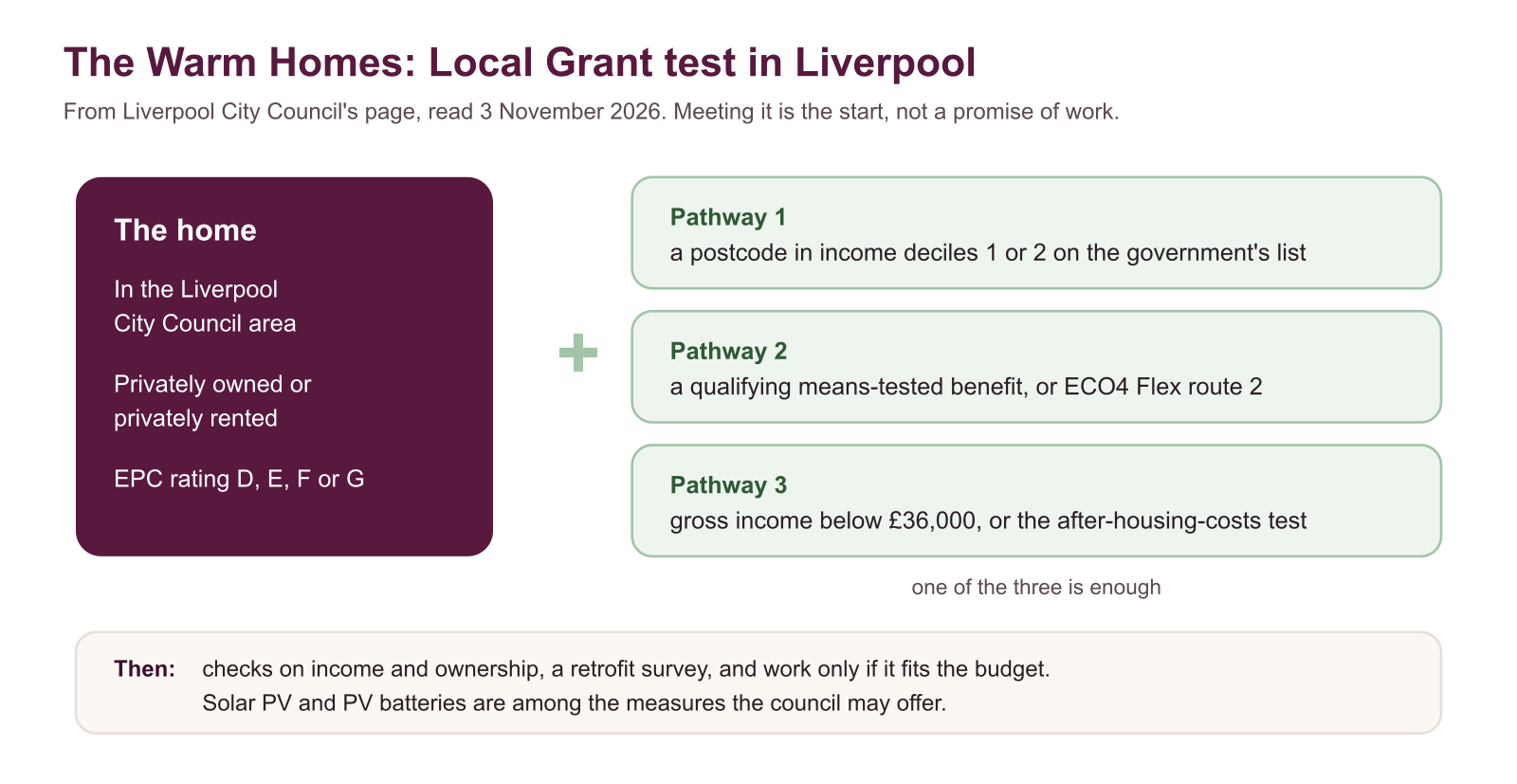
The home must be in the council's area, privately owned or privately rented, and rated EPC D to G. The household must then meet one of three pathways: an eligible postcode, a qualifying means-tested benefit, or income below £36,000 (or the after-housing-costs test).
Who decides: The council or the Combined Authority, after checking evidence such as ID, income and ownership.
Layer one
Does the home qualify?
Where it is. Liverpool City Council's Warm Homes: Local Grant scheme is for properties within the Liverpool boundary. If your home is in Sefton, Knowsley, St Helens, Halton or Wirral, a different body runs the scheme with the same national tests. See which council.
Who owns it. GOV.UK says the home must be privately owned, either by you or by your landlord. Homes owned by a council or housing association aren't covered, and Sefton Council's page says plainly that housing association tenants should contact their landlord instead.
How efficient it is. The home needs an energy performance certificate rated D, E, F or G. A home rated A, B or C is already above the scheme's threshold. You can look up a certificate on GOV.UK's register by postcode; GOV.UK also says you can find it during the application. See checking your EPC.
Layer two
The three household pathways
One is enough. The wording below follows Liverpool City Council's page; the Combined Authority and Sefton Council use the same three pathways.
| Pathway | The test | How to check |
|---|---|---|
| 1. Postcode | The home is in a postcode within income deciles 1 or 2 of the Indices of Multiple Deprivation | The eligible postcodes spreadsheet linked from the council's page |
| 2. Benefits | Someone in the household receives a qualifying means-tested benefit, or the household qualifies under ECO4 Flex route 2 | Your benefit award letters |
| 3. Income | Gross annual household income below £36,000, or meeting the after-housing-costs threshold for the household's size | Payslips, pension or benefit statements, and rent or mortgage payments |
Pathway 1
The postcode route
The government publishes a list of postcodes in the most deprived income deciles. The Combined Authority's page explains the effect: if you live in an eligible postcode, your household income doesn't matter for this route. That makes it the simplest pathway to check, and the one people most often miss.
Liverpool City Council's caution is worth repeating: being in an eligible postcode doesn't settle whether you'll be funded. Everything still depends on the assessment of your home and the money available, as applying and waiting lists explains. The Combined Authority adds that the list is updated occasionally. See checking eligible postcodes.
Pathway 2
The benefits route
The councils list the qualifying means-tested benefits:
- Universal Credit
- Income-based Jobseeker’s Allowance
- Income-related Employment and Support Allowance
- Housing Benefit
- Working Tax Credit or Child Tax Credit
- Pension Credit (Guarantee Credit)
The Combined Authority also lists benefits that don't qualify directly because they aren't means-tested, including Attendance Allowance, Disability Living Allowance, Personal Independence Payment and Armed Forces Independence Payment. It also says income from those benefits is excluded from the household income calculation, so if yours is one of them, the income route may still be worth checking.
Pathway 3
The income route, and the after-housing-costs test
The headline figure is gross annual household income below £36,000. GOV.UK puts it as usually £36,000 a year or less, and Liverpool's page says below £36,000; if you're near the line, ask the council how it applies it.
The second half of the route is the one that helps households who earn more but pay a lot for housing. The idea is to subtract rent or mortgage payments from income and compare what's left with a set level that depends on household size. The two pages word the starting point differently: Liverpool's says total gross income, the Combined Authority's says income after tax, so ask the council which figure it uses. The Combined Authority adds that council tax, utility bills, ground rent and service charges aren't deducted. The authority publishes tables of the maximum eligible income after housing costs. See the after-housing-costs test.
Evidence
What you may be asked for
Liverpool City Council says an engagement officer may ask for personal ID, financial information to verify household income, or property deeds. Sefton Council's page lists similar evidence. Gather it before you register:
- Photo ID for the applicant.
- Recent benefit award letters, or payslips and pension statements for everyone whose income counts.
- Rent or mortgage statements, if you're relying on the after-housing-costs test.
- Proof of ownership, or your landlord's details if you rent privately.
- Your EPC certificate number.
Common mistakes
Where applications go wrong
Assuming an L postcode means Liverpool. Several boroughs share L postcodes; the wrong council can't help you. Not checking the EPC. A home already rated C won't qualify, however low the income. Relying on a non-means-tested benefit. PIP or Attendance Allowance alone doesn't meet the benefits route. Forgetting the postcode route. It ignores income entirely. Paying someone to apply for you. The council's route is the GOV.UK portal, and there's no fee to register.
If you don't qualify
Other ways to get panels
Missing the tests isn't the end of the road. Paying yourself, with installation zero-rated for VAT until 31 March 2027, a Warm Homes loan for homeowners through a participating lender, and export payments under the Smart Export Guarantee are all open to households that don't qualify for the grant. See solar panels without a grant and a buying checklist.
Timing
When circumstances change
Eligibility is checked when the council processes your application, not when you register. In Liverpool, registrations made now are considered in year three, from 1 April 2027, so months can pass in between. If your income, benefits or household change in that time, tell the council when its engagement officer contacts you. A household that met the income route when it registered may not meet it later, and the reverse can happen too: a new benefit award or a drop in income can bring a household within a pathway.
More than one route
If you meet two pathways
You only need one pathway, but it does no harm to mention every one you meet. If your postcode is on the list and you also receive a qualifying benefit, say so: the council's checks differ by route, and having more than one can make verification simpler. The government's guidance tells councils to be satisfied that a household is genuinely in need, particularly on the postcode route, where income isn't checked.
Eligibility questions
Do I need an EPC to qualify?
The home must have an EPC rating of D, E, F or G. GOV.UK says that if you don’t know your home’s rating you can find it when you apply; you can also look it up yourself on the GOV.UK register.
My income is over £36,000. Can I still qualify?
Possibly, through another route: an eligible postcode, a qualifying means-tested benefit, or the after-housing-costs test, which deducts rent or mortgage payments before comparing income with a threshold for your household size.
Does Personal Independence Payment count as a qualifying benefit?
Not on its own. The Combined Authority lists PIP among benefits that don’t directly qualify, but says income from them is left out of the household income calculation, which can help under the income route.
I rent from a housing association. Can I apply?
No. The scheme is for privately owned homes. Housing association and council homes are improved through their landlords’ own funding.
If I meet the tests, will I get solar panels?
Not necessarily. Meeting the tests lets you be considered. A survey decides which measures suit the home, and funding is limited.
Sources for this page
- Liverpool City Council › Apply for a Warm Homes Local Grant, read 3 November 2026
- GOV.UK › Apply for the Warm Homes: Local Grant to improve a home, read 3 November 2026
- Liverpool City Region Combined Authority › Warm Homes Local Grant, read 3 November 2026
- Sefton Council › Warm Homes Local Grant, read 3 November 2026
- GOV.UK › Find an energy certificate, read 3 November 2026
- HMRC › VAT Notice 708/6, energy-saving materials and heating equipment, read 3 November 2026
- GOV.UK › Warm Homes loan: eligibility, read 3 November 2026
- GOV.UK › Smart Export Guarantee, read 3 November 2026
A question about solar funding in Liverpool?
Tell us what you're trying to find out. Your message reaches SEO-DONS LTD, which publishes this guide, and we answer by email. We don't run any grant scheme, decide eligibility or install panels, but we can point you to the scheme and the council that does.
What happens next
- Your message reaches SEO-DONS LTD, publisher of this guide.
- We answer by email, pointing to the scheme or council that applies.
- Any application is made to the council or scheme itself.