Paying yourself
Solar panels in Liverpool without a grant
For most Liverpool households, the honest answer to “is there a grant?” is no. That doesn't put panels out of reach. Three national rules shape the cost of paying yourself: the VAT zero rate, the Warm Homes loan for homeowners, and payment for the electricity you export.
Where you stand
Installation of solar panels and batteries in a home is zero-rated for VAT until 31 March 2027. Homeowners can apply for a Warm Homes loan through a participating lender. With an MCS certified system and a smart meter, the Smart Export Guarantee pays for what you send to the grid.
Who decides: You, with a lender if you borrow, and the supplier you choose for export payments.
VAT
Zero VAT on installation, until March 2027
HMRC's VAT Notice 708/6 covers energy-saving materials installed in homes. Solar panels are on the list, and so are batteries. Their installation in residential accommodation is zero-rated until 31 March 2027; from 1 April 2027 the rate becomes 5%.
Three details matter. The materials have to be installed, not just supplied: panels bought to fit yourself are standard-rated. The relief is for homes, not business premises. And work that isn't part of installing the panels, such as an unrelated roof repair done at the same time, may be charged separately. Ask the installer to show VAT clearly on the quote.
Borrowing
The Warm Homes loan, in plain terms
GOV.UK describes the Warm Homes loan as a loan from a lender, such as a bank, to help pay for energy saving improvements including solar panels and battery storage. To be eligible you must own the home, with or without a mortgage; it must be in the UK and residential. Lenders can add their own rules.
You must usually use an MCS certified installer, and you can't do the work yourself. GOV.UK also says you can't use a Warm Homes loan and other government funding for the same improvement, so panels due under Warm Homes: Local Grant can't also be paid for with the loan. We don't arrange loans or name lenders. If you're offered finance, read the total amount payable, the APR and the term before you sign, and check that the firm is authorised by the Financial Conduct Authority.
Side by side
Grant, loan or savings
| Warm Homes: Local Grant | Warm Homes loan | Paying outright | |
|---|---|---|---|
| Who | Lower-income households, EPC D to G | Homeowners; lender's checks apply | Anyone who owns the roof, or has the owner's consent |
| Pays back? | No | Yes, with interest | No |
| Who chooses the installer | The council's contractor | You; usually MCS certified | You; MCS certification needed for export payments |
| Solar certain? | No; the survey decides | Yes, if the lender approves | Yes |
| Timing | Liverpool: year three from 1 April 2027 | When the loan is approved | When you choose |
Exporting
Getting paid for what you send to the grid
Under the Smart Export Guarantee, GOV.UK explains, you're paid for every unit of electricity you feed back to the grid, though not for the electricity you use yourself. You need a meter that can provide half-hourly export readings, which usually means a smart meter, and you need to show that the installation and installer are certified under MCS or an equivalent scheme.
You apply directly to a supplier that offers a SEG tariff, and it doesn't have to be the supplier you buy electricity from. Ofgem lists the suppliers. Tariffs differ widely, so compare them. You can't receive SEG payments if you already get export payments under the old Feed-in Tariffs scheme.
What a roof produces
Liverpool's sunshine, in numbers
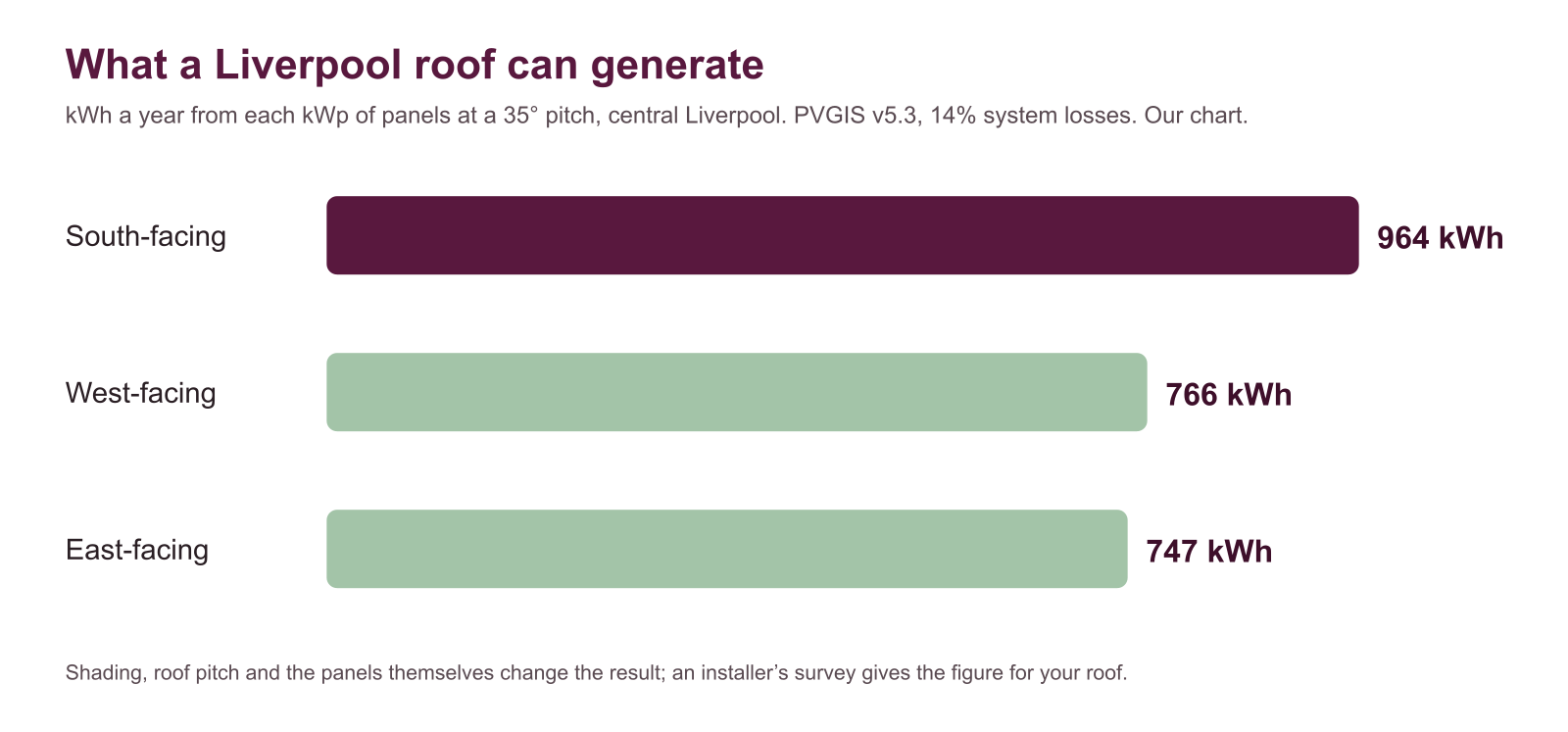
The European Commission's PVGIS tool, using satellite data from 2005 to 2023, estimates that each kilowatt-peak of panels at a 35° pitch in central Liverpool produces about 964 kWh a year facing south, 766 kWh facing west and 747 kWh facing east, after allowing 14% for system losses.
Those are starting figures, not a promise for your roof. Shading from chimneys, trees or neighbouring buildings, the exact pitch and the panels themselves all change the result. A good installer's quote should give an estimate for your roof and explain how it was worked out. We don't convert that into a saving, because what electricity is worth to you depends on your tariff and how much you use at home.
Before you buy
Checks that protect your money
- Get at least two written quotes, each with the panels, inverter, any battery, scaffolding and VAT itemised.
- Check the installer's MCS certification on the MCS website; you'll need the certificate for export payments.
- Ask whether the installer belongs to a consumer code, and how deposits are protected.
- Ask who notifies the network operator and what paperwork you'll receive.
- If the home is in a conservation area, check planning first.
See the full checklist and planning in Liverpool.
Timing
The 31 March 2027 date
The zero rate's end date is the one deadline in this picture that's written down. HMRC's notice says installations of energy-saving materials revert to the reduced rate of 5% from 1 April 2027. If you're planning to pay for panels and could do it either side of that date, the VAT difference is worth knowing. Don't let a salesperson use it to rush you, though: a fair quote will still be fair next week.
If you might qualify
Register for the grant anyway
If your household might meet one of the Warm Homes: Local Grant pathways and the home is rated D to G, registering costs nothing and keeps the option open; applying and waiting lists covers the portal and the timing. Just don't commission panels yourself while you wait for a decision: the grant pays for measures the council's survey recommends. See who qualifies.
Export tariffs
Choosing where to sell your surplus
Smart Export Guarantee tariffs aren't all alike. Some pay a fixed rate for every unit you export, some vary by time of day, and some are only available if you also buy your electricity from the same supplier. GOV.UK says your export supplier doesn't need to be the one you buy from, so you can choose the best export tariff and the best import tariff separately. Ofgem publishes the list of suppliers that offer SEG tariffs. Check the terms each year: rates and conditions change, and a tariff that suited you when the panels were new may not be the best later.
Home or business?
If you work from home or let rooms
The VAT zero rate in HMRC's notice is for residential accommodation. If part of your property is used for business, ask the installer how VAT applies before you sign, and keep the paperwork. Letting a room or working at the kitchen table doesn't usually turn a home into business premises, but a separate commercial unit on the same site may be treated differently. HMRC's notice is the authority if there's any doubt.
Paying-yourself questions
Is there VAT on solar panels?
Not on installation in a home until 31 March 2027: HMRC’s VAT Notice 708/6 zero-rates it. From 1 April 2027 the rate becomes 5%. Panels bought without installation are standard-rated.
What is a Warm Homes loan?
A loan from a participating lender, such as a bank, for energy saving improvements including solar panels and batteries. You must own the home, and the installer must usually be MCS certified. It’s repaid with interest.
Can I combine a loan with a grant?
GOV.UK says you can’t use a Warm Homes loan and other government funding to pay for the same improvement.
Will I be paid for electricity I export?
Through the Smart Export Guarantee, if the installation and installer are MCS certified and you have a meter that records half-hourly exports. You choose the supplier and the tariff.
Does this site arrange finance or installers?
No. We don’t arrange loans, name lenders or recommend installers.
Sources for this page
- HMRC › VAT Notice 708/6, energy-saving materials and heating equipment, read 3 November 2026
- GOV.UK › Warm Homes loan, read 3 November 2026
- GOV.UK › Warm Homes loan: eligibility, read 3 November 2026
- Financial Conduct Authority › The Financial Services Register, read 3 November 2026
- GOV.UK › Smart Export Guarantee, read 3 November 2026
- MCS › Find a certified installer, read 3 November 2026
- European Commission JRC › PVGIS photovoltaic tool (v5.3, SARAH3), read 3 November 2026
- Liverpool City Council › Apply for a Warm Homes Local Grant, read 3 November 2026
A question about solar funding in Liverpool?
Tell us what you're trying to find out. Your message reaches SEO-DONS LTD, which publishes this guide, and we answer by email. We don't run any grant scheme, decide eligibility or install panels, but we can point you to the scheme and the council that does.
What happens next
- Your message reaches SEO-DONS LTD, publisher of this guide.
- We answer by email, pointing to the scheme or council that applies.
- Any application is made to the council or scheme itself.